Laboratory Practical – Serum Albumin (Bromocresol Green Method)
Welcome to Chempath ePortfolios. This is your first post. Edit or delete it, then start writing!
To be updated soon
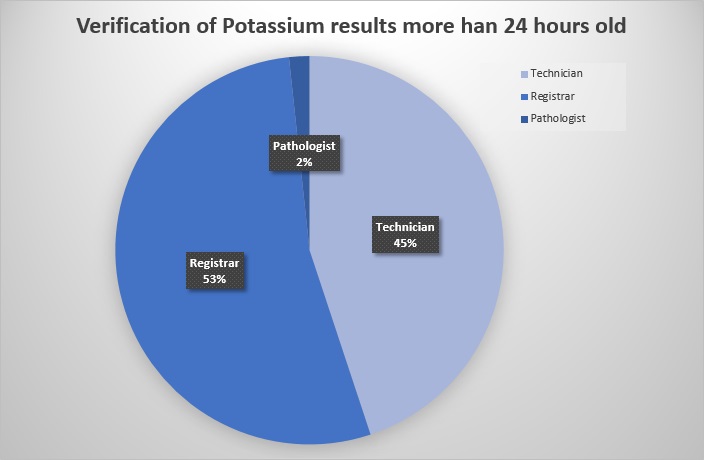
There was a concern about how many potassium results were being authorised from samples that are >24h old. It was thought to be likely due to registrar / pathologist non-compliance, but there was a particular concern regarding technologist non-compliance, as the night time results are not reviewed by the pathology team.
An extract was done over 10 days where age of sample was calculated and it was noted that 119 potassium results of samples >24h old had been signed out.
A review of the extract over 10 days revealed the following:
The current policy in our lab:
In a study done in 2018 by Dupuy et al., plasma potassium was found to be stable up to 12 h when the sample was centrifuged and stored at 4 °C. Potassium was the least stable analyte in whole blood and did not remain stable beyond 4 hours after sampling. Previous studies have also shown temperature to be an essential factor in stability. There is varying data on the stability of potassium in whole blood as a function of transport, storage conditions and type of tube.
According to the package insert of the Ion Selective Electrode for the Cobas analyser currently used in our lab, potassium is released from platelets during clotting and is susceptible to haemolysis (leakage from erythrocytes due to preanalytical handling).
Knowledge of analyte stability is crucial to interpret biological analysis with confidence.